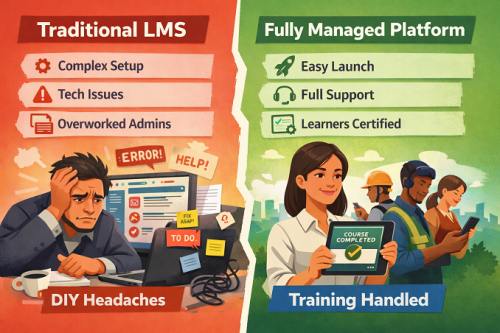
Traditional Online Training Platform vs Fully Managed Training Platform: What Nigerian Companies Need to Know
In Nigeria’s fast-growing business environment, companies with field staff, multiple offices, and mobile workforces face a critical question: how should training and certification be delivered efficiently and effectively? The answer often comes down to choosing between a Traditional LMS and a Fully Managed LMS solution.
Traditional LMS platforms provide a system where organizations upload content, manage learners, track progress, and issue certificates. While this gives control, it comes with hidden challenges: administrators spend hours enrolling learners, troubleshooting logins, updating materials, and chasing course completions. For businesses with drivers, security teams, field sales reps, healthcare outreach workers, or construction crews, the logistical burden of a traditional LMS can outweigh its benefits.
In contrast, a Fully Managed LMS takes the administrative load off the organization. Companies simply provide their training materials—videos, slides, PDFs—and learner information. The LMS provider uploads content, enrolls staff, generates logins, delivers courses via mobile devices, tracks progress, administers assessments, and issues certificates automatically. This model is especially effective for organizations with distributed teams across Lagos, Abuja, Port Harcourt, and beyond, where ensuring consistent training and compliance is a major challenge.
The benefits of a fully managed LMS are tangible:
-
Reduced operational workload: no need for HR or managers to manage training logistics.
-
Higher completion rates: staff complete courses on mobile, at their own pace.
-
Verified certification: certificates are automatically issued and centrally stored.
-
Scalability: train hundreds or thousands of employees across multiple locations without extra effort.
For Nigerian businesses in transportation, security, field sales, healthcare outreach, gig platforms, and construction, the choice is clear. While traditional LMS systems may work for office-based teams, a fully managed LMS ensures compliance, consistency, and confidence across every branch, site, and mobile worker.
Investing in a fully managed LMS is not just about technology; it’s about operational efficiency, workforce development, and business growth. In today’s competitive Nigerian market, companies that streamline training with a fully managed solution gain a significant advantage over competitors who stick to traditional LMS models.
#OnlinetrainingNigeria #FullymanagedLMSNigeria #Stafftrainingandcertification #WorkforcedevelopmentNigeria #Mobiletrainingplatform #LMSforfield staff